Our reading: False. Both halves of the graphic fail official data. UNHCR does not collect a worldwide religion figure for refugees, and it has said the circulating 85% claim is false. Ukrainians and Venezuelans, from majority-Christian countries, are about one-third of refugees and other people in need of international protection. Refugees mostly stay near home. Muslim-majority countries host millions of them. “56 Muslim countries” is a stale political-club count, not a legal asylum category.
The claim in the wild
A Facebook post from MAGA (Make Australia Great Again) Official page 2.0, posted as Admin on 22 October 2026, is at facebook.com/groups/1497621008117980/permalink/1805097554036989.
The graphic says: “Approximately 85% of the world’s refugees are muslim. But they don’t seek asylum in the 56 countries that are muslim. Why is that?” There is no UNHCR table, year, or definition of “Muslim country.” At capture the post had hundreds of reactions and 166 comments.
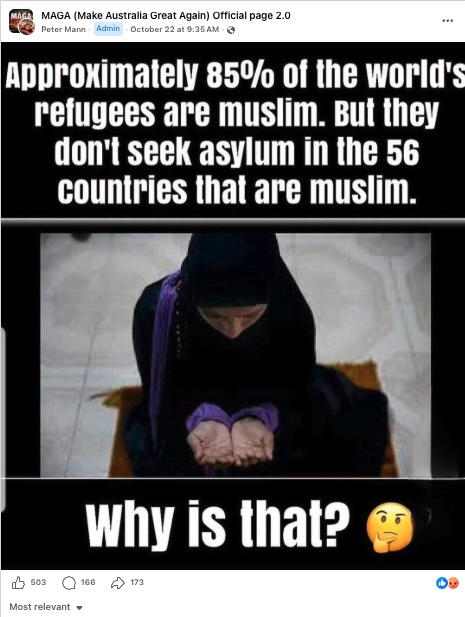
Several comments treated the graphic as true and added conspiracy or invasion language. One comment said “It’s all by design wake up.” Another: “Its an invasion.” Another: “They’re not really refugees.” Those comments are not evidence. We checked the numbers against UNHCR and related official sources.
Check: is 85% a real figure?
No. UNHCR’s Global Trends 2025 (end-2025 figures, published June 2026) counts people by legal status and country, not by faith. At the end of 2025 there were 35.6 million refugees, people in a refugee-like situation, and other people in need of international protection under UNHCR’s mandate, plus about 6 million Palestine refugees under UNRWA — 41.6 million in all. UNHCR’s registration system records religion only when it is relevant to a protection claim. Governments that supply the rest of the data often do not collect it, for privacy.
UNHCR told Full Fact that “the claim circulating on social media that 85% of all refugees are Muslim is false.” A spokesperson said that as of mid-2025 two-thirds of refugees and other people in need of international protection were from just five countries — Afghanistan, Syria, Sudan, Ukraine and Venezuela — and that “given that Venezuelans and Ukrainians, both majority Christian countries, comprise a significant portion of the overall population … the true proportion of refugees that are Muslims is likely to be much lower.”
That origin split still holds in the newer end-2025 tables. Seven in ten refugees and other people in need of international protection came from six countries: Afghanistan, South Sudan, Sudan, Syria, Ukraine and Venezuela. The largest origin groups were Venezuela 6.5 million, Ukraine 5.2 million, Syria 4.9 million, Afghanistan 3.7 million, Sudan 2.8 million and South Sudan 2.4 million. Venezuela plus Ukraine is 11.7 million — about 33% of the 35.6 million under UNHCR’s mandate. An 85% Muslim share cannot survive a third of the caseload coming from two majority-Christian countries, even before you count South Sudan (also majority Christian) or the fact that not every refugee from a Muslim-majority country is Muslim. Rohingya from Buddhist-majority Myanmar are a working example of the opposite.
Country of origin is not a religion census. Religious persecution can drive a minority out of a Muslim-majority state, and a Muslim minority out of a non-Muslim-majority state. That is why UNHCR will not convert origin tables into an 85% faith statistic. The type of comprehensive data needed to make that statement does not exist.
Check: where are refugees actually hosted?
Most people who flee stay close to home. At the end of 2025, 65% of refugees were hosted in neighbouring countries. Low- and middle-income countries hosted 68%.
The largest hosts of refugees and other people in need of international protection at end-2025 were Colombia (2.8 million), Germany (2.7 million), Türkiye (2.4 million), Uganda (1.9 million) and the Islamic Republic of Iran (1.7 million). Chad hosted 1.5 million, nine in ten of them Sudanese. Four in five Afghan refugees were in Iran (1.6 million) and Pakistan (1.3 million). Most Syrian refugees were in Türkiye (2.3 million), then Germany, Lebanon (532,400), Jordan (420,800) and Iraq (308,200). About 1.2 million Rohingya refugees were in Bangladesh. South Sudanese refugees were mostly in Uganda, Sudan, Ethiopia and Kenya.
Iran, Pakistan, Türkiye, Bangladesh, Jordan, Lebanon, Chad, Sudan, Iraq and Egypt are Muslim-majority. They are hosting, not empty. Reuters, checking the same meme in March 2026 against mid-2025 UNHCR data, found the Organisation of Islamic Cooperation’s 57 members hosted more than 16 million refugees, people in refugee-like situations and other people in need of international protection, and that Muslim-majority countries hosted more than 13 million. Full Fact, using Pew’s 2020 list of 52 Muslim-majority countries and territories, found those places hosted 45% of the world’s refugees in 2025. UNHCR’s Edgar Scrase has said at least seven of the largest host countries are predominantly Muslim — Bangladesh, Iran, Lebanon, Jordan, Türkiye, Chad and Pakistan — and together they host close to 30% of all refugees.
So the second sentence of the graphic is false on the facts that exist. Refugees from Muslim-majority countries do seek protection in neighbouring Muslim-majority countries. That is the normal pattern, not a loophole.
Check: is “56 Muslim countries” a meaningful asylum claim?
No. There is no international-law list of “Muslim countries” that a refugee must try first. Refugee status is about a well-founded fear of persecution, not a matching state religion. The 1951 Refugee Convention and customary non-refoulement do not require an applicant to apply only in a country of the same faith.
“56” is the stale headcount of the Organisation of Islamic Cooperation. The OIC describes itself as the collective voice of the Muslim world and has 57 members. Syria’s membership was frozen in 2012 and reinstated on 7 March 2025. The graphic is using last year’s club roster. Membership is not the same as “Muslim-majority”: Guyana and Suriname sit in the OIC with small Muslim minorities; Uganda is an OIC member and a large refugee host, and it is majority Christian. Pew’s 2020 research counted 52 Muslim-majority countries and territories, a different list again.
Several OIC or Muslim-majority states are themselves origin countries — Syria, Afghanistan, Sudan, Somalia. Others have not signed the 1951 Convention, or run limited individual-asylum systems. Hosting still happens: registration, temporary protection, residence permits. Venezuelans in Latin America are a large example of protection that is not a classic Western asylum grant. The graphic’s “don’t seek asylum” line treats one legal pathway as the only one that counts, then pretends the hosts are empty.
The comment that disputed the graphic
One comment said the 85% figure was “a completely made up fantasy, especially with the waves from ukraine and Venezuela”; that “2/3 of Muslim refugees settle in neighbouring Muslim countries”; and that the post was “trying to conflate economic migrants (Australia lets in heaps) with refugees (Australia lets in very few).”
We did not take that comment as evidence. Checked against UNHCR and Home Affairs:
- 85% / Ukraine and Venezuela. Directionally right. 85% is not a UNHCR figure. Ukraine 5.2 million plus Venezuela 6.5 million is about a third of the UNHCR-mandate total. That is enough, with South Sudan and the missing religion census, to kill 85%.
- “Two-thirds of Muslim refugees settle in neighbouring Muslim countries.” Directionally right that many do, and false as a precise UNHCR statistic. UNHCR publishes that 65% of all refugees are hosted in neighbouring countries. It does not publish a religion-by-neighbour split. Neighbours often share a majority faith: Syrians in Türkiye, Lebanon, Jordan and Iraq; Afghans in Iran and Pakistan; Sudanese in Chad and Egypt. That is the pattern. The “2/3 of Muslim refugees” wording is not a table you can look up.
- Conflating economic migrants with refugees. The graphic itself is about refugees and asylum, not skilled or family migration. Some comments under it treat all arrivals as one pile. Australia does run two different permanent programs. The Humanitarian Program was set at 20,000 places in 2025–26. The permanent Migration Program was set at 185,000, and Home Affairs delivered 132,222 skilled, 52,522 family and 256 special-eligibility places. Those streams are not the Humanitarian Program. That distinction is real. It does not make the 85% figure true, and it is not what the graphic claimed.
What is true
A large share of the world’s refugees come from Muslim-majority countries in conflict — Syria, Afghanistan, Sudan — and a large share of those people are hosted next door, including in Muslim-majority states. Another large share come from Ukraine and Venezuela. Most refugees live in low- and middle-income countries, not in Australia or the rest of the rich world. Australia’s humanitarian intake is a small, separate program from its skilled and family migration program.
None of that is secret, and none of it requires an 85% faith statistic or a closed club of “56 Muslim countries.” This check is of the graphic’s numbers. It is not a brief for or against Australia’s Humanitarian Program, immigration levels, or anyone’s faith.
What to do
- Do not treat a meme as UNHCR data. If a refugee claim is real, it has a table in Global Trends or the Refugee Data Finder.
- Country of origin is not a religion. UNHCR has said so.
- Australia’s humanitarian places and its Migration Program are published separately by Home Affairs. They are not the same intake.
- Report the Facebook post as false information.
Sources
- Facebook post: MAGA (Make Australia Great Again) Official page 2.0, posted as Admin, 22 Oct 2026, groups/1497621008117980/permalink/1805097554036989, screenshots 25 Oct 2026
- UNHCR Global Trends 2025 (end-2025; published June 2026); PDF
- UNHCR Refugee Data Portal; Refugee Data Finder; refugee hosting metrics
- Full Fact: Muslim-majority countries host millions of refugees (UNHCR: 85% claim is false)
- DW: Why “85% of refugees are Muslim” is false
- Reuters: Muslim-majority countries host millions of refugees, not none (25 Mar 2026)
- Euronews: UN spokesperson, 85% “unlikely”
- OIC: 57 members; Syria reinstated 7 Mar 2025
- Home Affairs: 2025–26 Humanitarian Program discussion paper (20,000 places)
- Permanent Migration Program 2025–26 (185,000); 2025–26 Migration Program report
This fact-check may be AI-assisted and can contain errors. Disclaimer.